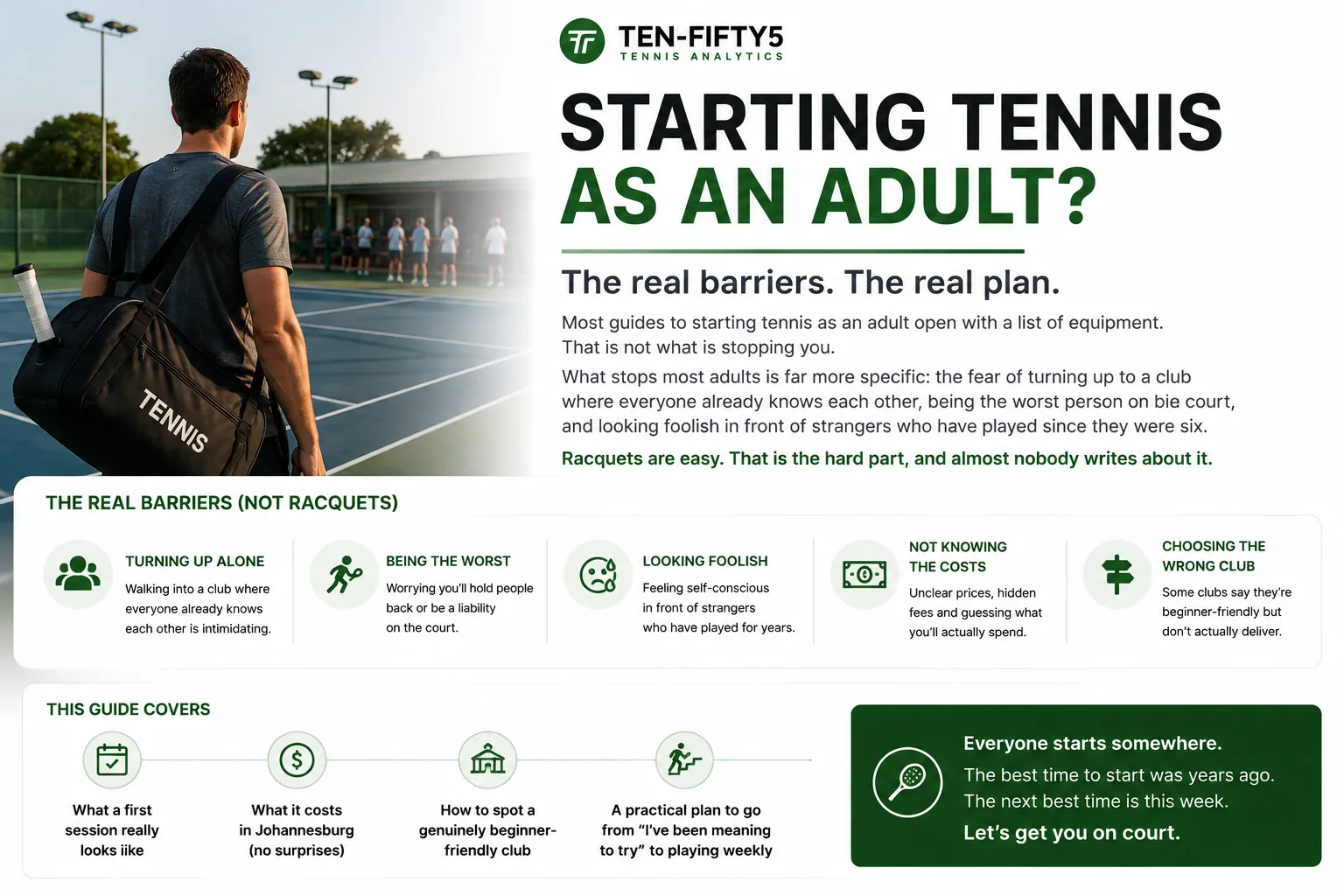
Most guides to starting tennis as an adult open with a list of equipment. That is not what is stopping you.
What stops most adults is far more specific: the fear of turning up to a club where everyone already knows each other, being the worst person on the court, and looking foolish in front of strangers who have played since they were six. Racquets are easy. That is the hard part, and almost nobody writes about it.
So this guide is about the actual barriers. What a first session looks like, what it costs in Johannesburg, how to tell a genuinely beginner-friendly club from one that merely says it is, and how to get from "I have been meaning to try" to playing every week.
The three things adults are actually worried about
"I will be the worst one there." In a beginner group, everyone is. That is the entire point of a beginner group — it exists precisely so that nobody in it is being measured against players who have been at it for twenty years. The adults in that session are, without exception, as self-conscious as you are.
"I am not fit enough yet." This one is backwards, and it is the single most common reason adults delay for a year or more. You do not get fit and then play tennis. Tennis is how you get fit. A beginner session is mostly technique work, feeding and short rallies — it is nothing like the two-hour baseline slugfest you are picturing.
"I do not know anyone to play with." This is the only genuinely legitimate concern of the three, and it is the one that determines whether you are still playing in six months. Lessons teach you to hit a ball. They do not, on their own, give you anyone to hit it with. Choose a club with social play and group sessions, not just a coach with an hour free.
What a first session actually looks like
For a complete beginner, a first group session is far less intimidating than most people expect:
- You will not play a match. Almost no beginner session starts with competitive play. You will spend most of it in short rallies, hand-feeding and controlled drills at half pace.
- You will hit the ball. A common fear is spending an hour missing. A coach feeding at the right pace means you will make contact from the first few minutes.
- Nobody is watching you. Everyone else on the court is concentrating on their own contact point.
- It is roughly an hour. Long enough to feel like you played, short enough that you are not wrecked the next day.
The honest expectation for the first month: you will be able to rally gently, serve underarm or with a basic overhead action, and keep score. That is genuinely enough to start playing socially, and it is a much lower bar than most adults assume.
What tennis coaching costs in Johannesburg
Across Johannesburg, private coaching generally sits somewhere in the R200 to R800 per hour range depending on the coach's experience and whether the session is private or group. Group coaching is meaningfully cheaper per session, and for a beginner it is usually the better option regardless of budget — you get the rallying practice, the social contact and the lower pressure that a one-on-one lesson cannot give you.
A sensible starting pattern for most adults is one group session a week plus one social hit, adding a private lesson occasionally when something specific needs fixing. That is enough contact time to improve steadily without turning your new hobby into a second job.
Court hire is separate from coaching at most clubs, though club membership often covers it. Check what a membership actually includes before comparing headline prices — a slightly higher membership that includes unlimited court time is frequently cheaper in practice than a low one where every booking is billed. You can see how NextPoint structures courts, lessons and membership on the pricing page.
What you actually need to buy
Very little, and less than most shops will tell you:
- A racquet. Borrow or buy an inexpensive one to start. Do not spend heavily before you know whether you prefer a heavier, more stable frame or a lighter one. Many clubs and coaches have racquets you can use for the first few sessions.
- Court shoes. The one item worth getting right immediately. Running shoes are built for forward motion and offer almost no lateral support — tennis is a side-to-side game, and this is where beginners most often turn an ankle.
- Balls. A tube is inexpensive. Coaches supply them for lessons.
That is the entire list. No kit, no branded clothing, no restringing decisions. Those all come later, if ever.
How to tell whether a club actually welcomes beginners
Every club says beginners are welcome. Some mean it. A few things separate the two:
- Are there adult beginner groups, or only juniors and squads? A club whose entire coaching programme is built around junior development often has nowhere for an adult starter to go.
- Is there organised social play? This is the single best predictor of whether you will still be playing next year. A club that arranges games for you solves the "nobody to play with" problem that ends most adult tennis careers before they start.
- Can you see availability before you commit? Being able to look at real court and coach availability — rather than phoning to ask — tells you a lot about how easy the club will be to deal with once you are a member.
- Can you try before joining? Any club confident in its coaching will let you experience it before asking for a year's membership.
- What happens in winter and after work? In Johannesburg the tennis-friendly weather is generous, but if you work full time you will mostly play in the evening. Floodlit courts are the difference between playing year-round and quietly stopping in May.
Where NextPoint fits
We are at Killarney Country Club in Houghton, with eight courts — hard and clay — floodlit for evening play, and a coaching programme that runs from complete beginners through to the High Performance squad.
For an adult starting out, the two relevant parts are the group programmes — Cardio Tennis and social play are both genuinely beginner-friendly — and the fact that you can see live court and coach availability and book online rather than phoning and hoping. There is also a free week — create an account and court bookings are on us for 7 days, no commitment, with lessons and classes staying pay-as-you-go. It is the honest way to answer the question this whole article is really about: is this going to be awkward, or is it going to be fun?
If you would rather start with the courts than with a coach, the guides to booking a court in Killarney and what it costs to hire a court in Johannesburg cover the practical side. If you would rather start with lessons, our guide to tennis lessons in Johannesburg explains the formats.
Frequently asked questions
Am I too old to start playing tennis? No. Tennis is one of the few sports that genuinely accommodates a start at any age — it is low-impact relative to running, it scales to your fitness, and club tennis is full of people who picked it up in their forties, fifties and later.
How long before I can play a real game? Most adults can rally and play a scored social game within about four to six weeks of starting weekly lessons. Playing well takes much longer, but playing enjoyably comes quickly.
Should I take group or private lessons as a beginner? Group, in most cases. It is cheaper, it gives you rallying practice against people at your level, and it introduces you to the players you will go on to hit with. Add private lessons later for specific technical work.
Do I need to be a member of a club to take lessons? Not usually. Most clubs, including ours, offer coaching to non-members, though membership generally makes court time cheaper if you play regularly.
What is the best way to meet other players at my level? Organised social play and group sessions, every time. Ask any club you are considering how they arrange games for new members — the answer tells you almost everything.
The only step that matters
Everything above is detail. The single thing that separates adults who play tennis from adults who have been meaning to try it is booking one session and turning up to it.
Pick a group session, borrow a racquet, wear proper court shoes, and accept that the first twenty minutes will feel strange. By the end of the hour it will not. That is genuinely all there is to it.
Ready to play?
Book a court, a lesson with a named coach, or start a free week of court bookings at NextPoint Tennis.
Start your free week